
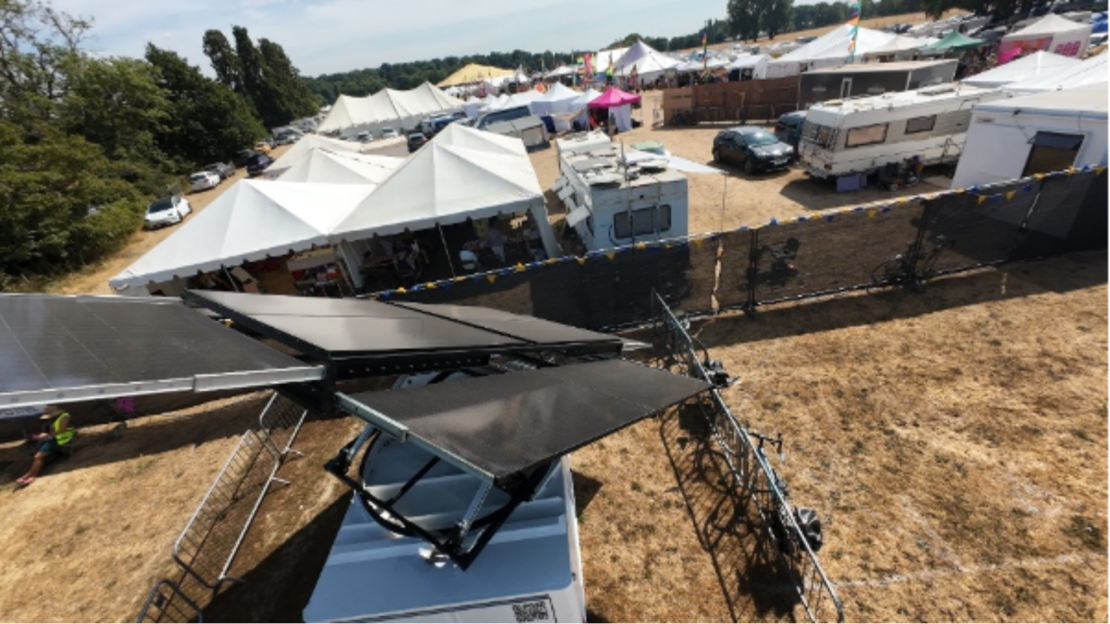

In this guest blog Mandy Sutton, Festival Experience Manager at Warwick Folk Festival (WFF) shares the journey to replace their standard diesel generator with a hybrid solar generator unit over a 14-day build, festival, and breakdown period. The project was a great success, helped by the increased sunshine this July, they achieved 6 full days run entirely on solar power, cutting daily average generator runtime from 24 hours down to just 4.5 hours. Fuel consumption was kept to 315 litres compared to an estimated 1,680 litres required by a conventional 60kVA generator running continuously, saving £1,979.25 in fuel costs and preventing 4,327 kg of CO₂ emissions. The onsite environment was also improved with 6 full days of silent, zero-emission power around sensitive festival areas, including accessibility services and office hubs. Read the full case study below where Mandy shares the on the ground practicalities of bringing this project together:
“Warwick Folk Festival has run for 45 years bringing folk music and dance to a local, national and international audience. From Thursday to Sunday on the 4th weekend in July, we transform farmer’s fields into a thriving festival of up to 5000 people consisting of ticket buyers, volunteers, performers, traders and more.
From our traditional base at Warwick School, in 2022 we moved to a beautiful greenfield site with lots of potential to build a festival just as we wanted but with no access to grid power.
Without the school infrastructure to supply power, we were now solely dependent on generators to meet all power needs.
We’ve made great strides towards a sustainable festival over the last few years (reusable cable ties, reclaimed materials for site art etc) but the sticking point was Diesel generators.
I’d been researching alternatives for three years –
Options investigated were:
- Get a power supply installed (the quote was for more than our annual turnover)
- Large batteries (Ecotricity’s Grid Faeries turned us down – possibly we’re too small to make it worth their while)
- Switch to HVO fuel (resistance from Site manager due to an earlier bad experience)
- Solar generator (Very expensive to hire compared with traditional generators)
We had already switched to LED lighting and looked for other savings. We agreed that where we can’t do without diesel, we would offset to amount used with the help of our sustainability consultant.
The site managers had been sceptical about solar having enough power to do what we needed. After persuasion, and the benefit of a small financial surplus from a very successful 2025 they agreed to trial for 2026 as a low-risk way of testing the idea of using solar to run the wider festival.
As the cost of hiring a solar generator is much higher than a fully diesel one, we sought funding. When this was unsuccessful, we spoke to Solgen who offered to help us kick start the project with a discount and support.
Of the three generators we hire in, this year, one was Solar powered with back up diesel.
I spoke to three suppliers of Solar generators and two had 1 month min hire and prohibitive cost. Solgen however, were happy to offer two weeks hire and were very supportive in helping me persuade the rest of the team and helping with the cost.
The full spec is in the appendix but is was 60kVA which was felt to be sufficient for the load. It was delivered and set up for us by Solgen who monitored it throughout the hire period. The unit rotated automatically to maximise exposure – it was very cool to watch!
Things to bear in mind from an operational perspective is that the hybrid generator takes up more space and that the backup generator kicks in and goes off at unpredictable times – obviously optimising efficiency but worrying to site managers who have learned to associate a generator going off as a signal that they need to jump to attention.
What it powered: Lights around site and stage, sound for concerts, office equipment, charging site transport, mobility scooter charging and volunteer welfare.
Key Outcomes
- Operational Efficiency: Achieved 6 full days run entirely on solar power, cutting daily average generator runtime from 24 hours down to just 4.5 hours.
- Direct Cost & Resource Savings: Reduced total fuel consumption for the targeted infrastructure by over 81%, saving £1,979 in fuel costs.
- Measurable Carbon Reduction: Prevented more than 4.3 tonnes of CO₂ emissions over the 14-day hire period.
- Improved On-Site Environment: Provided silent, zero-emission power around sensitive festival areas, including accessibility services and office hubs, for six full days.
- Baseline for Future Scaling: Delivered concrete operational data to help plan a broader phase-out of diesel generators across the rest of the site in future years.
We’re delighted with the results we got this year but are aware that we had above average sunshine for July.
We’re hoping that this project will be a flagship for other festivals to see what can be achieved.”
Mandy Sutton is Festival Experience Manager at Warwick Folk Festival, she has been part of the team since 2013. She’s been going to Folk festivals (and dragging the family along) for 40 years, as a Morris dancer, hanger on and musician. She has a special interest in sustainability and accessibility. In 2026, WWF achieved the bronze charter from Attitude is Everything that reflects the changes in attitude and practical steps they have taken as a festival to be more inclusive.