

For fifty years, the live events sector has operated under a persistent industry myth: that a show’s electrical demand matches the maximum power ratings stamped onto the back of its kit. Built on worst-case spec-sheet estimates, these inflated figures force productions to over-specify temporary infrastructure, over-hire massive diesel generators, and rule out clean power solutions before a show even leaves the warehouse. In this article, Alexis Parkin—Sustainability Officer at 4Wall Europe and touring screen technician with The Prodigy—explores how this reliance on “peak fiction” cripples the sector’s transition to clean energy, and presents real-world data showing that actual power draw is often a fraction of conventional assumptions.
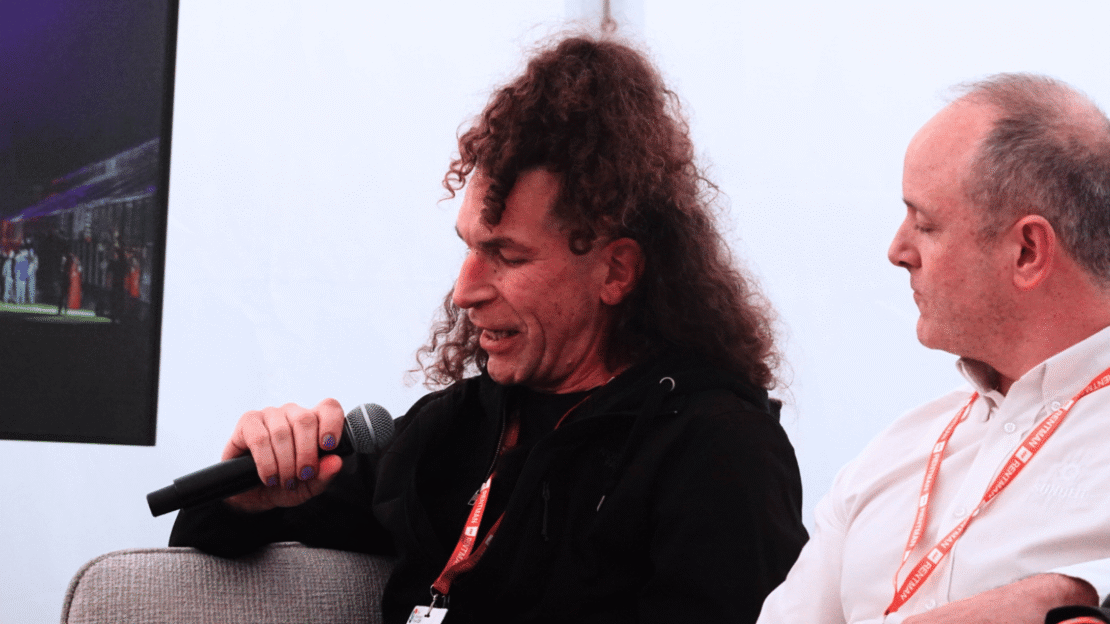
Speaking at the recent Sustainable Event Summit (SES26), Alexis delivered the main stage AV and power specification, working closely with power provider Sunbelt Rentals in the lead up to the summit he demonstrated how precision metering supports accurate power provision – with the result that the even ran fossil-free on a solar power generator. Outlining why right-sizing power cannot remain an exclusive privilege for stadium headliners, Parkin introduces the Production Power Database, an open-access wiki designed to provide free, empirically verified draw data for the entire industry. Read his article below:
“The live events industry doesn’t know how much power it uses. That data needs to be free, and it needs to be free now.
Every piece of equipment my industry sends out the door has a number on the back: the maximum electrical load it can draw. That number describes the worst moment of the device’s life — the lamp strike, the full-white flash, the loudest transient of the loudest song — held indefinitely. It does not describe what the device does for the rest of the show.
For fifty years we’ve planned power around these numbers and got away with it, because diesel generators are remarkably forgiving of being lied to. As events move to grid and batteries, that forgiveness ends. The gap between the plate and the meter becomes a decision-killer.
A live demo
At the Sustainable Events Summit this October, 4Wall Europe supplied the AV for the main stage. Convention says a rig like that gets a 32A three-phase supply. We specified 16A — half the connection.
During my talk I put a live power monitor on screen. Through the show, all three phases sat between 5 and 7 amps (roughly 1.2–1.6kW per phase at 230V). Then we pushed the LED wall to full white — the worst case its rating is built on — and two phases peaked at around 10 amps (about 2.3kW per phase). Still well short of the 16A specified, and less than a third of what convention would have asked for.
That was one small stage. The same gap exists on every stage in the country.
How the fiction gets built
Lighting sums the rated wattage of every fixture. Video sums every panel and processor. Audio sums the amplifier ratings. Each adds a margin, production adds another, and the power supplier rounds up to the next generator in stock. Every link is rational. The result is specifications stacked on specifications.
And the starting figures were already fiction. Music’s average power is often a tenth or less of what amplifiers are rated for. An LED wall’s rating assumes every pixel at full white; real content averages perhaps a third to half of that. A lighting rig is rated as if every fixture runs at full at once, when most of the plot is dark or dimmed at any moment. Stack it all up and the paper requirement can land at three to five times what the show will ever draw.
Diesel forgave us. Batteries and grid don’t.
Generators run efficiently between roughly 40% and 80% of capacity. An oversized one just burns more fuel per kilowatt-hour, quietly. When Glastonbury monitored 126 of its generators, a large proportion were found to be significantly oversized. The spreadsheets said the site was correctly powered. The meters said otherwise.
Batteries and grid charge that penalty up front, on paper. Batteries are sized and priced on stored energy and delivery rate; hand a supplier a figure three to five times too high and the quote is three to five times too big. Grid connections are costed by capacity, so an inflated figure turns “this site can be connected” into “it can’t.” The decision goes back to diesel — not because the alternatives couldn’t do the job, but because the number was wrong.
Measure first, then electrify
Through 2026 the shift has gone mainstream. Ultra in Miami took a fourth of its seven stages off generators and named measuring site energy demand as the central focus. Reading Festival ran a stage from batteries. The West of England’s Clean Power Pilot spent the summer guaranteeing clean power to outdoor events across the region.
Its showcase was Forwards, Team Love’s festival on the Bristol Downs — the clearest example yet of measurement unlocking the transition. In 2025, Team Love metered the real draw of both main stages. This August, with those numbers in hand, they ran the main stage on green hydrogen and the second stage on batteries. A year of measuring, then a diesel-free plan sized to what the show actually used.
Massive Attack’s battery-powered Act 1.5 and Coldplay’s battery tour tell the same story. You don’t commit a show to a finite store of energy without knowing what it consumes.
The data has to be free
Massive Attack had the Tyndall Centre. Coldplay had a dedicated battery partner. Glastonbury had a remote monitoring system across the whole site.
The village fete doesn’t. Neither does the 300-capacity conference, the regional theatre tour or the community festival in its second year. These events are the overwhelming majority of the industry, and they’ll never commission their own metering programme. They’ll size from the plate, because the plate is all they have — and the plate will tell them batteries are too expensive and the grid connection too big.
Right-sized power can’t stay a privilege of events that can afford research partners. The measured figures need to exist, and they need to be free to everyone who specifies power, whatever the size of their show.
That’s why I’m building the Production Power Database at prodpwr.wiki: a free, wiki style resource listing manufacturers’ figures alongside real measured draw for production equipment, able to total a whole kit list so anyone can size a supply from real numbers. Every figure comes from a single unit tested on registered, calibrated equipment, and isn’t validated until readings come from more than one independent organisation. I tested the idea at SES26, and the response was overwhelming.
It needs manufacturers, rental houses, production companies and technicians logging data. Every supplier already has the kit, and metering one unit at a time is cheap. For rental houses, it’s also a commercial position: the first suppliers who can tell clients here is what our kit actually draws will be the ones the transition is built around.
The move away from diesel will be decided in spreadsheets, months before a cable is run, by whatever numbers are in them. Right now those numbers are fiction. Replace them with measured reality, make that reality free, and a remarkable amount of what looks impossible turns out to have been possible all along.
The plate tells you what the kit could do, once, on its worst day. The meter tells you what your show actually is.
This is a shortened version. Read the full article, with sources, on Substack → The Production Power Database pre-launch mailing list is open at prodpwr.wiki.
Follow Alexis Parkin on Linkedin https://www.linkedin.com/in/alexis-parkin-879910121/
Visit 4Wall https://europe.4wall.com/
__
This Q&A originally appeared in our November 2026 Vision for Sustainable Events newsletter. Sign up to receive monthly event sustainability news, case studies and guest blogs direct to your inbox.