
In this guest blog by Pauline Bourdon, Founder of sustainable events and touring consultancy Soliphilia, and Forum Member at Vision for Sustainable Events Forum, shares the highlights and learnings from her recent trip to a Symposium on Culture and Climate Action, held at the 53rd edition of the Festival Cervantino in Mexico.
Pauline joined the Symposium to share updates on Vision for Sustainable Events’ Green Code of Practice project and the forthcoming Show Must Go On Climate Transition Plan for the UK Live Events Industry, and extended her trip to attend the Mexican edition of her event client, MUTEK International Festival of Digital Creativity and Electronic Music, and Huerto Roma Verde, a regenerative community. Read her key takeaways and points of inspiration from the trip:
“This October, I was lucky enough to be invited to speak at a Symposium on Culture and Climate action in Mexico. The two day symposium was curated by the brilliant team at Julie’s Bicycle, in collaboration with British Council, University of Guanajuato and Festival Cervantino. The purpose of this event was to connect UK and Mexico based artists, cultural leaders, and organisations that are responding to the climate crisis through creativity. After travelling for the first time in Mexico in January to dive into the history of Maya, Puuc and Toltec civilisations, this new opportunity to visit the country and connect with Mexico based professionals was one I couldn’t miss!
I spent the first five days in Mexico City, discovering the green corridor of Condensa which helps increase the air quality and cool the area and its residents, the multiple records and vintage shops in Roma, visiting the Aztec site of Teotihuacan, and finally Huerto Roma Verde, a community “laboratory of BioSocial resilience”. This alternative paradise is a perfect example of what citizens can do when coming together in a community movement. A “flagship of environmentalism, urban permaculture and community development,”, the team at Huerto Roma have developed their own community development method “Regenerative Hikuri” which supports the growth, design and implementation of their “biosocial projects and programs”. At Huerto Roma, you will find a space for community development, Soil Regeneration, Waste Management & Decontamination, Citizen platform and hubs and Emergency Support.
I strongly recommend anyone travelling to Mexico City to visit this inspiring space.
By a lucky coincidence one of my festival clients, MUTEK, was organising their Mexican edition during my trip which felt like an exciting opportunity to dive into the city’s music scene. MUTEK specialises in digital arts and electronic music, showcasing some of the best, cutting edge and forward thinking artistic projects. I visited the festival one evening with the Quebec delegation and was blown away by the scale of the production and the quality of the line-up curation. The space, Maravilla Studios, is a century old large film studio that provided a large-scale playground for the artists programmed at MUTEK Mx. In the main room, I spent a couple of hours mesmerised by Circle of Live who invited contemporary dancers to perform during their 4hrs live set and then saw, Ash Fure‘s set led by “acoustic interference and physical intensity” left me so curious of her stage process.
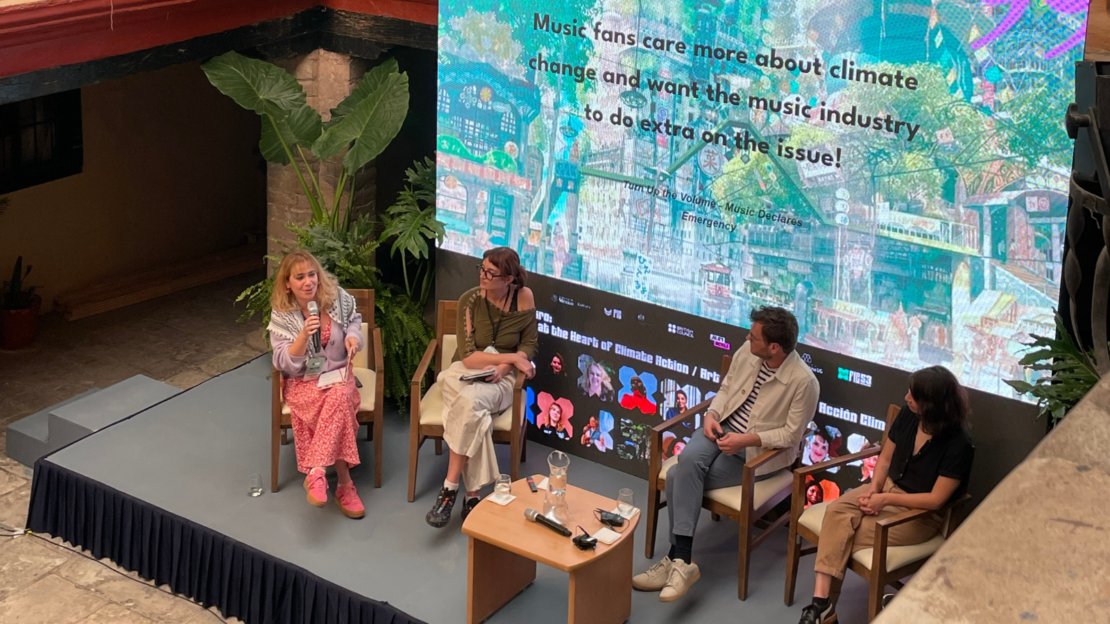
Finally, it was time to meet the rest of the Julie’s Bicycle delegation and head to Guanajuato. The Festival Cervantino is a world renowned arts festival which showcases music, theater, dance, opera, visual arts, and street performances from Latin America and around the world. The United Kingdom alongside the Mexican state of Veracruz were the guests of honour of the 53rd edition of the festival. For two days, Julie’s Bicycle symposium was the hub of some of the most honest, inspiring and radical conversations for culture and climate action I’ve seen in a while.
At a time when Latin American communities are being oppressed by the US, climate activists are being killed for protecting the planet and international corporations continue to extract resources and pollute the land in Mexico – it felt particularly important to ground our work & reflections in respect, solidarity, radical thinking and empathy. We could feel the emotions and the excitement of the students from Guanajuato University in attendance throughout the panels.
The symposium was opened by a keynote speech from Brian Eno and Cathy Runciman (EarthPercent) with an invitation to “find the others” and to keep nature at the heart of culture, which quickly became a recurring motto for us all. ! Each panel showcased the power of community, with a radical approach to culture and climate justice – essential to create a truly fair, kind and better future. We did find The Others, a vibrant international movement that invited us to rethink our democracy, the design of our cities and use the storytelling power of arts and culture to find more.. Others. On the second day, I presented some of the brilliant work from the Live Events industry in the UK – focusing on frameworks such as Vision for Sustainable Events’ Show Must Go On Climate Transition Plan for the UK Live Events Industry and Green Events Code of O PracticeP. We spent most of our time discussing the economic and social realities of the countries we live in or come from, connecting on our various practices as professionals, citizens and activists, all with a good dose of humour and laughter. After all, community joy is instrumental in keeping us all sane!
It’s hard to pinpoint highlights from these two days. Every single person and organisations invited inspired me to be more bold, radical and creative in my own practice – from the rainharvesting technologies of Isla Urbana, to the Transition Neighborhoods of Civic Square, to the Animal Puppets crossing the world with The Herd, the activism of Tori Tsui at the intersection of climate & music, the campaigns for Clean Air from Love Ssega, all the way to the regenerative approach of Huerto Roma Verde, the degrowth ethos of Zoe Rasbash, the circular design of What Design Can Do or the research project helping Indigenous Fisherwomen, The Grandmothers of Guacaporito, to adapt to extreme heat.
Perhaps, one idea from Keir Oldfield-Lewis (British Film Institute) resonated specifically with me and how I imagine the role cultural institutions can play in creating safe, resilient and enjoyable spaces for people to exist. The idea is to create a map of cultural venues who can provide sheltered and cool environments during extreme weather conditions all around the country.
This means that people can find accessible, safe and community led-spaces easily during a heatwave for example. If paired with a publicly- funded policy for inclusive pricing of cultural events, this idea could revolutionise the way people interact with arts, culture and creative resilience.
This blog originally appeared in our December 2025 Vision for Sustainable Events newsletter. Sign up to receive monthly event sustainability news, case studies and guest blogs direct to your inbox.